
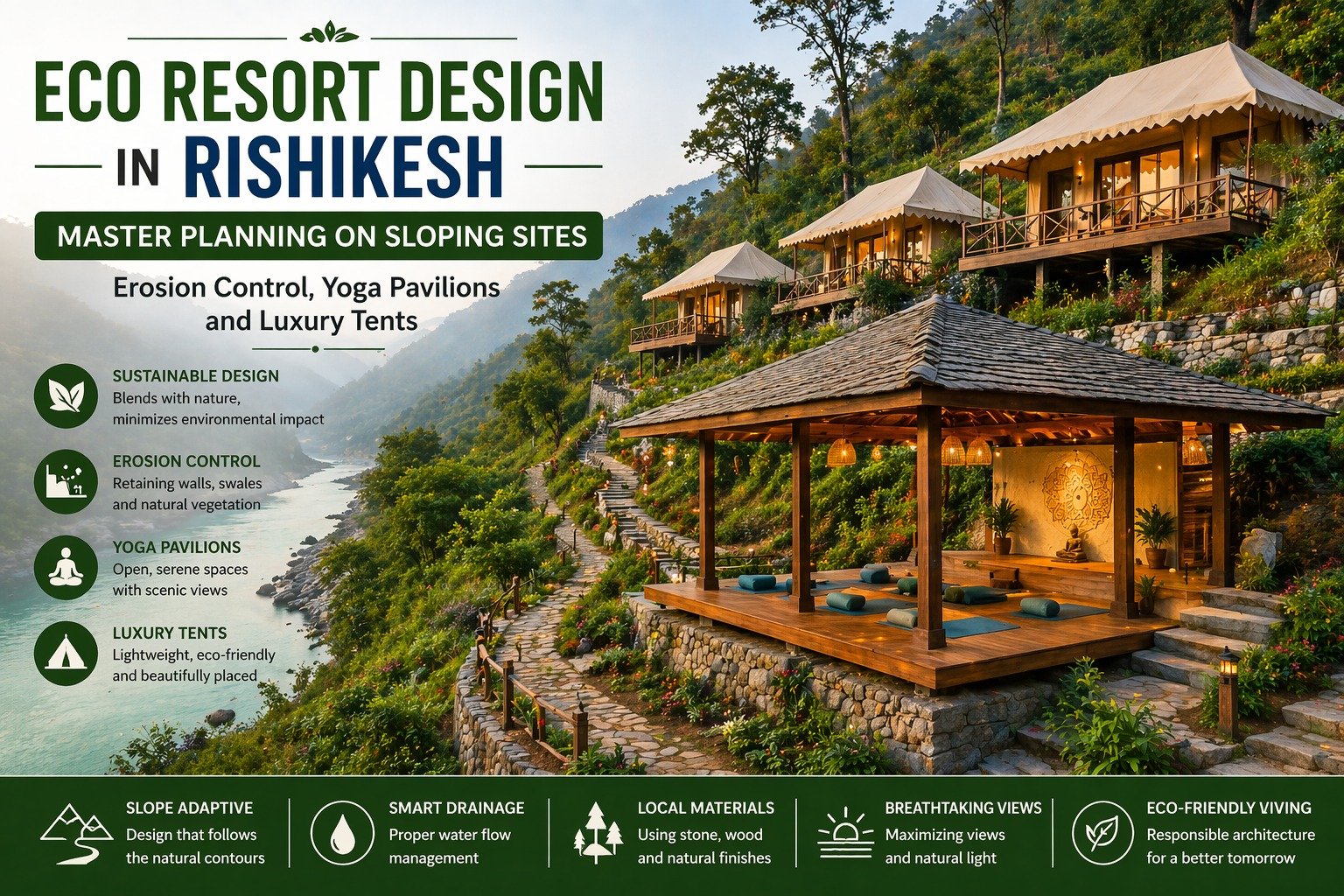
Eco Resort Design in Rishikesh focuses on smart planning for sloping sites. Learn erosion control, yoga pavilion layouts, and luxury tent design for sustainable hillside resorts.
Rishikesh is known as the Yoga Capital of the World. Every year, thousands of tourists come here for meditation, yoga, and adventure sports. Many of them want to stay in eco friendly resorts that blend with nature. But building on a sloping site in Rishikesh is not easy. The land is steep, the soil is loose, and the monsoon rains can cause landslides.
At Architecture Consultant, we have experience in designing on difficult terrains. Our team knows how to handle soil erosion, water drainage, and foundation stability. In this blog, I will share practical tips for master planning an eco resort on a sloping site in Rishikesh.
Understanding the Challenges of Sloping Sites in Rishikesh
The biggest challenge is soil erosion. When you remove trees or dig into the slope, the soil becomes loose. During the monsoon, water flows down quickly and takes the soil with it. This can damage your foundation and even cause a landslide. The second challenge is water drainage. Water naturally flows downhill. If you do not plan your drainage properly, water will enter your buildings.
The third challenge is access. Roads on slopes are narrow and steep. Construction vehicles may not reach your site easily. You need to plan a safe and stable access road. The fourth challenge is foundation. Normal foundations do not work on slopes. You need special stepped or pile foundations.
How to Control Erosion on a Sloping Site
The first rule is to change the land as little as possible. Do not cut the slope into a flat platform. Instead, design your buildings to follow the natural shape of the land. Use a technique called cut and fill. You cut soil from one area and fill it in another area. But be careful not to overdo it.
Plant trees and grass on all exposed soil. The roots hold the soil together. Use retaining walls made of stone or concrete. These walls hold the soil back and prevent it from sliding. Make sure the retaining walls have drainage holes so water does not build up behind them.
Create swales and channels to guide water away from your buildings. Swales are shallow ditches filled with grass or stones. They slow down the water and let it soak into the ground. Never let water flow freely down the slope.
<h2>Designing Yoga Pavilions on a Slope</h2>
Yoga pavilions are the heart of any resort in Rishikesh. They should be placed on the most stable part of the slope. The best location is the mid slope area where the land is not too steep. The pavilion should face east so guests can see the sunrise. The floor should be made of wood or stone. It should be completely level.
If the slope is very steep, you can build a split level pavilion. One part of the floor is higher than the other. This looks beautiful and saves soil. Use open sides so the wind can flow through. Add a solid roof to protect from rain and sun.
<h2>Placing Luxury Tents on a Sloping Site</h2>
Luxury tents are perfect for sloping sites because they are lightweight. You do not need heavy foundations. But you still need a flat platform for each tent. Build small wooden decks on stilts. The stilts go into the ground and the deck is level on top. This keeps the tent above the soil and allows water to flow underneath.
Place the tents at different heights along the slope. Each tent gets a private view. Connect the tents with wooden walkways or stone paths. Avoid concrete paths because they do not look natural. Make sure each tent has a small private deck facing the view.
<h2>How Architecture Consultant Plans Eco Resorts in Rishikesh</h2>
We start with a site visit. Our team studies the slope, the soil, the trees, and the water flow. We then create a master plan that works with nature, not against it. We use local materials like stone and wood. We also handle all structural calculations for retaining walls and foundations. Our architecture consultant team in Dehradun has successfully completed many sloping site projects.
<h2>Frequently Asked Questions</h2>
1. Is it safe to build on a sloping site in Rishikesh?
Yes, it is safe if you follow the right techniques. You need a proper soil test, good retaining walls, and a strong drainage system. Avoid very steep slopes above 30 degrees. Also avoid areas that have had landslides in the past. A qualified architect can tell you if your site is safe.
2. What is the best type of foundation for a sloping site?
Stepped foundations and pile foundations are the best. A stepped foundation follows the shape of the slope. Each step is a separate block of concrete. A pile foundation uses long concrete columns that go deep into the ground. Your structural engineer will decide based on the soil report.
3. How much does it cost to build on a slope compared to flat land?
Building on a slope is more expensive. The extra cost is usually 20 to 30 percent more than flat land. This is because of the retaining walls, special foundations, and extra drainage work. But the views and the privacy are worth it. Guests will pay more to stay in a hillside resort.
4. Can I plant trees after construction to prevent erosion?
Yes, planting trees is very effective. But you should also plant grass and shrubs because they grow faster. The best trees for slopes are those with deep roots like bamboo, banyan, and neem. Plant them at least three meters away from your buildings so the roots do not damage the foundation.
5. How do I plan the water supply on a sloping site?
You can collect rainwater in a tank at the top of the slope. Then let gravity bring the water down to your buildings. This saves electricity. For waste water, use a septic tank at the lowest point of the slope. Do not let waste water flow into natural streams.
6. What is a swale and why is it important?
A swale is a shallow ditch that is planted with grass or stones. It slows down rainwater and lets it soak into the ground. Swales prevent erosion and recharge groundwater. On a sloping site, swales should be placed above every building to catch water before it reaches the building.
7. How do I design a road on a steep slope?
The road should zigzag up the slope. This is called a switchback road. The slope of the road should not be more than 10 percent. The road surface should be gravel or concrete. Add drainage channels on both sides. Also add retaining walls on the downhill side of the road.
8. Do I need a special permit for building on a slope in Rishikesh?
Yes, you need a building permit from the local authority. In addition, you may need an environmental clearance because sloping sites are ecologically sensitive. You also need a no objection certificate from the forest department if there are trees on your site. Your architect can help you get all these permits.
9. How long does it take to build an eco resort on a sloping site?
The construction time is longer than flat land because of the extra work. A small resort with five luxury tents and one yoga pavilion may take 12 to 15 months. The design phase also takes longer because of the site analysis and structural calculations.
10. Why should I choose Architecture Consultant for my Rishikesh resort?
We have experience in difficult terrains. Our team understands soil, water, and structural safety. We design eco friendly resorts that are beautiful and safe. We also provide architectural design services from concept to completion. Visit our website to see our projects and contact us for a free consultation.
0 Comments